WooCommerce vs PrestaShop — Which Platform Should You Choose for Your Shop in 2026?

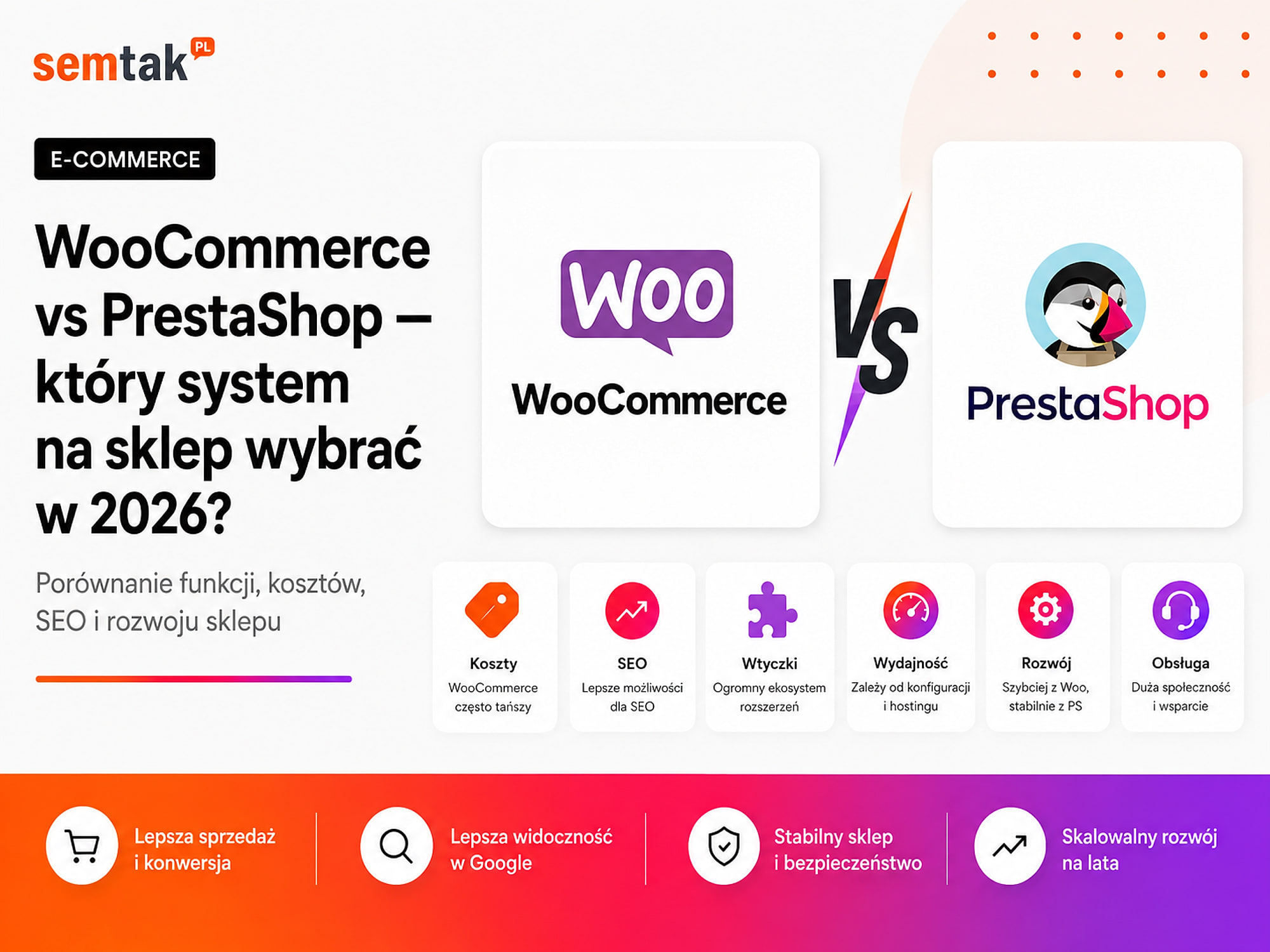
WooCommerce vs PrestaShop in short: choose WooCommerce when you want maximum flexibility, the best SEO and full control on top of WordPress; choose PrestaShop when you are building a typically shop-focused, product-heavy business (large catalogues, variants, multiple markets) and prefer a dedicated e-commerce engine. Both are free, open-source systems and both have been selling in Poland for years. The difference does not lie in the licence cost (it is zero), but in the philosophy and in who will technically build and maintain your shop. See also whether PrestaShop is a good solution.
In short
WooCommerce vs PrestaShop: choose WooCommerce when you want maximum flexibility, the best SEO and full control on top of WordPress (shop plus content plus blog). Choose PrestaShop when you are building a typically product-focused business with a large catalogue, many variants and markets, and prefer a dedicated e-commerce engine. Both are free and open source; the difference lies not in the licence but in the philosophy and the people behind it. If you are also weighing up other engines, we compare WooCommerce vs Magento.
WooCommerce vs PrestaShop — how do they differ at their core?
The most important architectural difference is this: PrestaShop is a standalone e-commerce engine (the entire platform is a shop), whereas WooCommerce is a plugin for WordPress that adds shop features to a content management system. This is no minor detail — almost all of the other differences follow from it.
WooCommerce inherits the WordPress ecosystem: tens of thousands of plugins, themes, a huge community and excellent content tools (blog, landing pages, content marketing). PrestaShop is narrower, but in return it is natively "shop-like" — multilingualism, multistore, advanced product variants and inventory management come as standard, without bolting on more plugins.
WooCommerce vs PrestaShop comparison table
Below is a concise summary of the most important criteria. Treat it as a decision map, not a verdict — in a real project each of these points depends on the implementation.
| Criterion | WooCommerce | PrestaShop |
|---|---|---|
| Type of system | WordPress plugin (CMS + shop) | Standalone e-commerce engine |
| Licence | Free (open source) | Free (open source) |
| Flexibility / content | Very high, strong blog and content | High in the shop area, weaker content |
| Large catalogues / variants | Good, sometimes needs optimisation and plugins | Very good natively (combinations, inventory) |
| Hosting requirements | Low–medium, easy shared hosting | Medium–higher, VPS preferable for a large shop |
| SEO | Very good (URL control, content, schema) | Good, stronger with correct configuration |
| Community / specialists (PL) | Very large, easy to find help | Large, but a narrower niche |
| PL integrations | Very broad (BaseLinker, couriers, gateways) | Broad, mature in commerce |
| Entry barrier | Lower, familiar WordPress panel | Higher, its own admin panel |
Costs — where the money really goes
This is where the most common misunderstanding arises. Neither WooCommerce nor PrestaShop has a licence fee — you can download both for free. The real costs are:
- Hosting/server — with WooCommerce it is usually cheaper to start (it runs on typical shared hosting); PrestaShop, with a larger catalogue, prefers a more powerful environment (often a VPS).
- Theme and implementation — the graphic design, the build, and the configuration of payments and shipping.
- Extensions / modules — in both systems some features are paid add-ons. In WooCommerce, many things are handled by free WordPress plugins; in PrestaShop, the official modules are sometimes paid, but they are often mature and "shop-grade".
- Technical maintenance — updates, backups, security. This cost is similar and real in both cases.
The fairest rule of thumb: neither of these systems is "free" in practice — only the licence is free. The specific budget range depends on the scope; you will find indicative implementation packages on our packages page.
Hosting and performance
WooCommerce has a lower entry barrier on the server side — you can set it up on popular shared hosting. That is an advantage at the start, but beware: a growing WooCommerce shop (lots of products, filters, traffic) can put a strain on weak hosting and slow the shop down. The configuration then becomes decisive: caching, the database, query optimisation.
PrestaShop can be more resource-hungry, but it is designed for commerce, so with a proper environment it copes well with large catalogues and many variants. In both cases the key is the hosting and the tuning, not the platform name itself — which is why the outcome often comes down to the implementer, for example a technical WooCommerce agency. If you are planning WooCommerce, start with a solid foundation — we covered this in the guide on how to choose hosting for WooCommerce, and on speed itself in the article on how to speed up a WooCommerce shop.
SEO — which platform ranks better?
The platform itself does not do the SEO for you — but it does give you the tools. WooCommerce on WordPress has a clear "content" advantage here: full control over URL structure, category content, the blog, structured data (schema) and speed. Plus mature SEO plugins (Yoast, Rank Math). This makes it very rewarding for building organic visibility.
PrestaShop also ranks well when it is correctly configured: clean addresses, canonical URLs for variants, control of duplication in filters. A frequent problem in PrestaShop is duplicate content and an excess of addresses from filtering — manageable, but it requires deliberate work. Whatever you choose, the outcome will still be decided by the technology and the content — see Core Web Vitals in a WooCommerce shop.
Community and availability of specialists
WooCommerce wins on the scale of its community — as part of the WordPress world it has a huge base of guides, plugins and implementers. It is easier to find help, easier to replace someone, and there is less risk of "locking in" a project to a single developer.
PrestaShop has a narrower but mature and commerce-oriented community. You will find specialists, although there are fewer than in the WordPress ecosystem. For a solo entrepreneur this means one thing: with WooCommerce you will more often handle small changes yourself in a familiar panel.
Integrations with the Polish ecosystem
This criterion often tips the balance in Polish conditions. Both systems are strong here, but they differ in the maturity of their plugins:
- WooCommerce — very broad integrations: BaseLinker, couriers (InPost, DPD, parcel lockers), payment gateways (Przelewy24, PayU, Tpay, BLIK), accounting, wholesalers, Allegro. Many of them come in a free version or as cheap plugins.
- PrestaShop — equally present in Polish commerce, with mature courier and payment modules; integration with BaseLinker and marketplaces is also standard.
If your model is based on order automation, marketplaces and multi-channel shipping, both will do the job — WooCommerce's advantage is the abundance of ready-made, cheap plugins. You will find more on this in the articles on WooCommerce integrations with accounting and BaseLinker and on shipping in WooCommerce.
The verdict: WooCommerce vs PrestaShop
Honestly: there is no single winner for everyone. There is a fit with your business.
- Choose WooCommerce if you want strong SEO and a blog, a lower entry barrier, a familiar panel, the broadest community and cheap integrations. This is usually the best choice for small and medium-sized shops that are simultaneously building content and visibility in Google.
- Choose PrestaShop if you are building a typically product-focused shop with a large catalogue, extensive variants, many languages/shops, and you prefer a dedicated commerce engine without a CMS "overlay".
In practice, for most Polish companies in our niche we recommend WooCommerce — mainly because of its flexibility, SEO and maintenance cost. But it is a context-dependent recommendation, not a dogma. If you are also torn between other systems, see the comparisons of WooCommerce or Shopify and the complete guide to a WooCommerce shop.
Frequently asked questions
Which is better: WooCommerce or PrestaShop?
For small and medium-sized shops that want strong SEO, a blog and a low entry barrier — WooCommerce is usually better. For large, heavily product-focused shops with many variants and markets, PrestaShop will often prove a better fit. The business model decides, not the ranking itself.
Which system is cheaper?
Both have a free licence, so price does not settle it. To start, WooCommerce usually works out cheaper (lighter hosting, more free plugins). With large catalogues the costs of both systems even out — what counts is the hosting, the extensions and the technical maintenance.
Which system ranks better in Google?
WooCommerce has a "content" advantage thanks to WordPress (blog, URL control, schema, mature SEO plugins). PrestaShop also ranks well, but it requires deliberate configuration to avoid duplicate content from filters. In both cases the outcome is decided by the technology and the content, not the platform itself.
Can you migrate from PrestaShop to WooCommerce?
Yes. The migration is feasible (products, categories, customers, orders), but it requires a plan and the preservation of URLs along with 301 redirects, so as not to lose your positions in Google. It is a technical project — done rashly, it can wipe out your visibility for months.
Which system should I choose for a large shop with thousands of products?
Both will cope with good hosting. PrestaShop has natively stronger variant and inventory management, while WooCommerce, with very large catalogues, requires database and cache optimisation. The decisive factor is the implementation architecture, not the platform name itself.
We will help you choose and implement the right system
At the SEMTAK Marketing Agency we advise without religious wars over platforms, and we technically implement what genuinely fits your business:
- WooCommerce store development — a fast implementation ready for SEO, payments and PL integrations.
- Online store SEO — squeeze the maximum out of your visibility in Google.
- SEO audit — we will check what is blocking your shop's sales, regardless of the platform.
Not sure how much you are losing through a weak shop? Work it out with our lost sales calculator.