

Joomla! or WordPress? Which CMS should you choose?

Right at the start, before beginning work on a website, a service portal or an online store, we face the choice of a CMS. The decision — Joomla! or WordPress — is, contrary to appearances, not at all that simple, regardless of whether we need a site for our own individual needs or for a medium-sized company or an extensive web portal. To help with these dilemmas, we present our comparison of these two systems, which we hope will make the decision easier.
In short
For most companies the better choice is WordPress — it is simpler to use, has over 50,000 plugins (including WooCommerce for an online store) and a huge community, so it works well for company websites, blogs and stores. Joomla! offers greater development flexibility and fits extensive portals better, but it is harder to update and maintain. The choice depends on the scale of the project.
Why exactly the choice between WordPress and Joomla!? Well, these are the two most popular content management systems (CMS)
Joomla – (Swahili for "all together!", masculine, approximate pronunciation "joomla") — a content management system written in PHP, using a MySQL database, distributed under free software terms. From Wikipedia
WordPress — a content management system designed mainly for running blogs. It is written in PHP and uses a MySQL database. It is distributed under the GNU General Public License and is available free of charge. From Wikipedia
Our discussion of the above solutions will be organised into the following categories:
-
Use case:
Joomla! — is most often used when building extensive projects. It has a richer base of web solutions and is easy to integrate or reprogram them to suit your needs. Its main advantage is its development capabilities and support for the advanced mechanisms that characterise large and complex portals.
WordPress — has a very clear and intuitive admin panel. Thanks to the smaller number of options, it is friendly to users without much experience. With this system we can create both simple and more complex websites as well as online stores. As for visual qualities, on the internet you will find more visually striking projects built precisely on WordPress.
-
Updating the website content as well as updating the CMS and add-ons.
Joomla! — notifications about a newer version appearing show up automatically, however the update causes users problems. It is not automated.
WordPress – the system and most add-ons update themselves automatically.
-
Customisation, modifications.
Joomla! –With basic knowledge of HTML and PHP, Joomla can be modified very freely thanks to its modular structure. Joomla currently has a base of just under 8,000 add-ons. This is a number of extensions sufficient to effectively increase the functionality and capabilities of a site. On the Joomla pages you will find both free and paid add-ons. All plugins are divided into categories such as e-Commerce, sliders, galleries, CRM, forums, chats and specialist plugins.
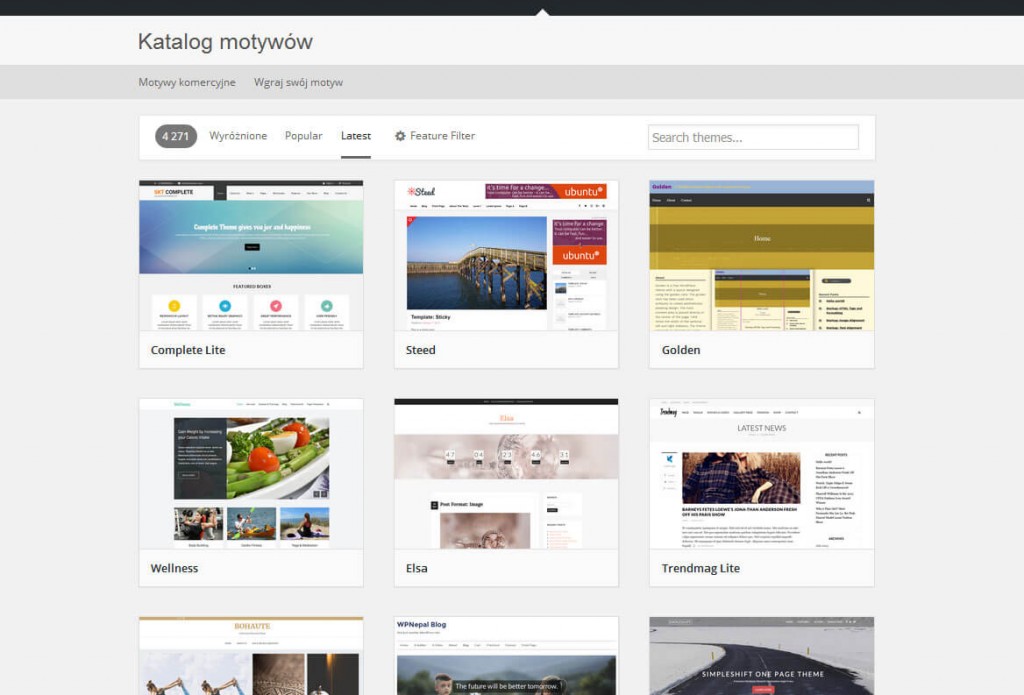
WordPress – is a system that offers 50,000 plugins, thanks to which it is possible to continuously extend its functionality. These are both paid and free solutions, as well as ones that come in a free and a paid version. Transforming the site or installing an online store option can be done with the WooCommerce plugin. WordPress offers plugins that help with positioning and more. The WordPress.org site provides technical information, download statistics and very helpful reviews of them.
-
Technical support
Joomla! — It is very easy to find a solution to common problems as well as an answer to non-standard issues. The largest Joomla forum in Poland has over 61,000 registered users. Every year Joomla Day Poland takes place in Poland. The system has a very good project documentation site, but it is not translated into Polish.
WordPress – has an impressive user base that solves problems and develops the system on forums as well as at large conferences and meetups. Fixes for bugs and problems appear quickly and do not go unanswered for long.
-
Statistics – WP and Joomla! in numbers
According to W3Techs, a company that analyses the IT market, 27.6% of websites in the world run on WordPress — data from 1 March 2017. Joomla! accounts for 3.3%, from Wikipedia
|
Joomla!
|
WordPress
|
6. Projects
Joomla!
- Official international Peugeot website – http://www.peugeot.com/en
- A store with themed templates – https://www.joomla-monster.com/
WordPress
- Polish Ministry of National Education – https://men.gov.pl/
- The second largest climbing portal in Poland – http://climb.pl/
as well as
- New York Observer, New York Post, TED, Thought Catalog, Williams, USA Today, CNN, Fortune.com, TIME.com, National Post, Spotify, TechCrunch, CBS Local, NBC
Summary:
In summing up our reflections on the WordPress and Joomla CMSs, we cannot unequivocally point to which is better and which is worse, or which one is worth recommending and which is not. Both content management systems perform their task superbly. We can only suggest that it is worth analysing the intended purpose and deciding on WordPress if you have in mind a simple, uncomplicated company website, and choosing Joomla!for an advanced service portal or web portal.